
All companies take decisions. Some decisions are minor; for example, choosing a supplier or a date to launch a campaign. But other decisions are more major, such as the quantity of goods to purchase or the markets where the firm should grow, along with the number of employees to hire in the coming quarter. Usually, these decisions are based on previous experience, present data, and some assumptions.
The challenge with assumptions is that they do not scale well. Decisions that are taken without having complete and/or outdated information become very costly at a certain scale. For instance, an online business in Dubai which buys too much inventory for a low-performing season has tied up capital. Similarly, a logistics company in Riyadh which does not estimate the amount of demand correctly for the holidays period is unable to scale itself quickly enough.
Predictive analytics is the discipline of using historical data, pattern recognition, using models and statistics to provide well-informed forecasts about what is likely to happen so that decisions can be based on facts rather than on gut feeling. This blog post will cover all these aspects and explain how companies in UAE and GCC countries from all industries are utilizing it in 2026.
What Is Predictive Analytics And What It Is Not
A Forecast, Not a Crystal Ball
Predictive analytics is the process of analysing historical data to identify patterns, and then using those patterns to generate probabilistic forecasts about future outcomes. The important term here is probabilistic it calculates what is more probable or less probable from the information at hand. Probabilistic does not make guarantees. It makes the process of decision-making clearer through providing useful information.
It may be compared to the weather forecast. The meteorologist does not know how the weather will be on the next day. However, studying different pieces of information, he can say with a certain probability that there is seventy percent possibility of raining tomorrow. Companies may do this when forecasting some situations. How high is the probability of demand for a certain group of products for the next quarter? Who are those customers who will probably stop buying next month? What department is the most probable to cause the problem with delivery this month?
It is also important to distinguish predictive analytics from the reporting that most businesses already do. Traditional business reporting provides information about things that have already occurred: sales from last month, traffic from last quarter, customer retention from last year. All these pieces of information are important and useful, but they are past-oriented. Predictive analytics is future-oriented. It uses things that already occurred as a basis to forecast upcoming events.
How Predictive Analytics Works Without the Technical Jargon
A Simple Process That Turns Business Data Into Forward-Looking Insight
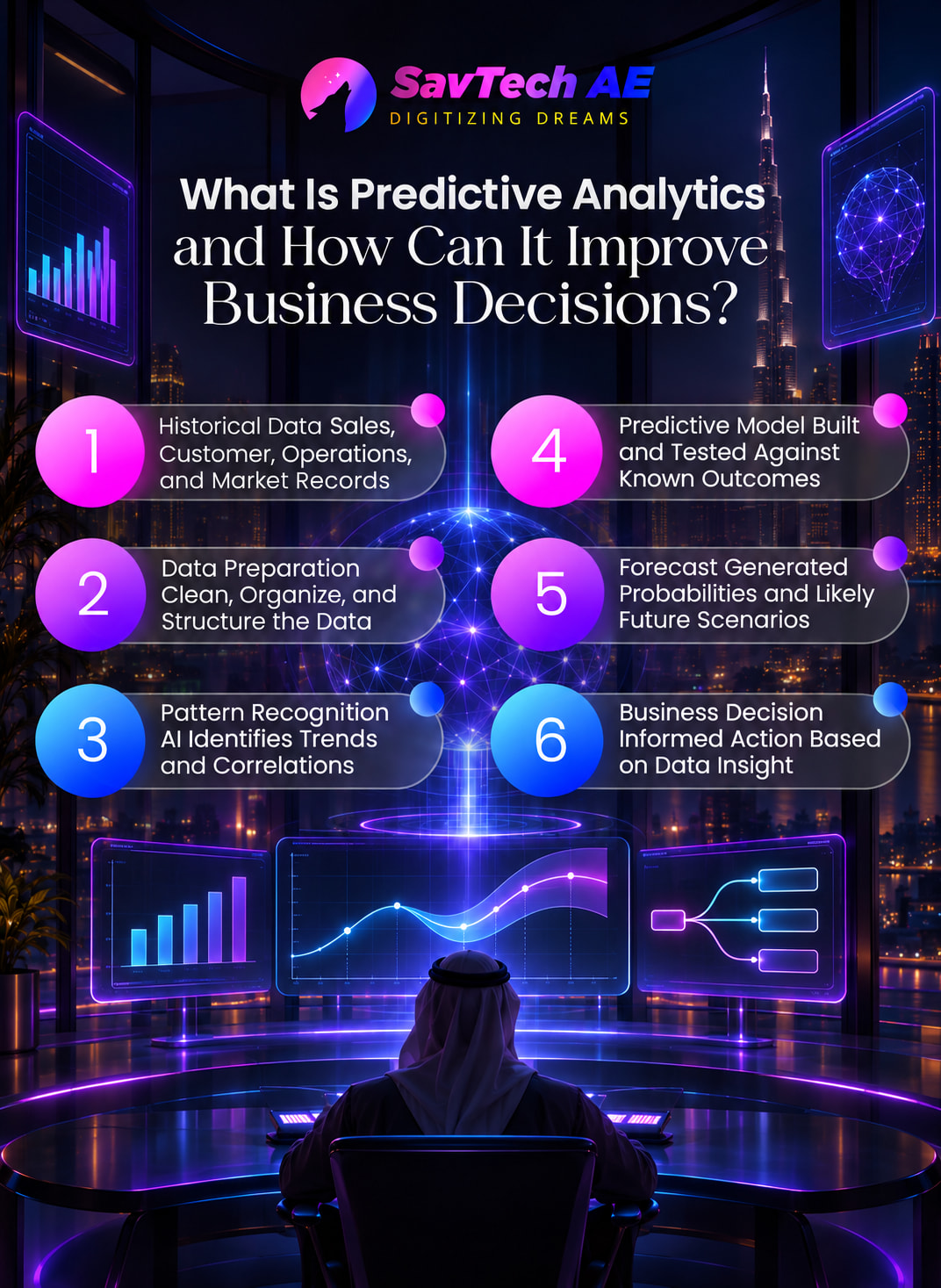
Predictive analytics for business follows a process that is more accessible than it sounds. Data comes first the historic data which any company collects through its operations: sales, customer behavior, delivery times, seasonal patterns, market data. It is the raw material.
Next comes the cleaning and organization of data. Patterns can be recognized reliably only when the data is correct and consistent. Data preparation may not be glamorous work, but it is critical. The forecast will be unreliable if the data used as the basis for prediction is of poor quality. The quality of the prediction depends on the quality of the data.
Having prepared the data, models are constructed to recognize the patterns. It can be statistical models and it can be machine learning algorithms whatever model recognizes the relationships in the historic data. These models are validated using known results and then are applied to forecasting future events. The result is a probability assessment: considering historic and current trends, what is the probability of certain result in the near future? This probability estimate forms the basis for the business decision which has much more weight than an arbitrary business decision.
Predictive Analytics vs Business Intelligence Understanding the Difference
Knowing What Happened vs Knowing What Is Likely to Happen Next
Business intelligence solutions and predictive analytics are often mentioned in the same conversation, but these are used for different things at different stages of the decision process. Knowing this distinction can help businesses realize the capabilities of each methodology.
Business Intelligence tries to answer one simple question, which is ‘what happened?’ Through dashboards and reports, business intelligence presents you with past data. This could be revenue generated last month per region or the best selling products this quarter or even customer acquisition costs for this year. These are vital pieces of information, but the fact remains that it is historical in nature.
Predictive business intelligence the combination of BI and predictive analytics This adds a dimension of looking ahead. It goes like this: based on what happened, this is what will happen next. The finance team whose BI dashboard displays declining margins in a certain product category, coupled with the predictive analytics showing the same trend of decline based on supply chain trends, has a lot more information to make decisions than the team working off the historical data. The BI dashboard provides the sign/symptom; predictive analytics tells the possible course of action that the business must take. Prescriptive analytics comes after the predictive – it does not only predict; it also gives recommendations for actions to take.
For most of the GCC firms starting out on data analytics, the predictive layer is the most immediate use of investment.
How Predictive Analytics Improves Business Decisions Across Key Areas
From Demand Forecasting to Risk Management Practical Applications
Demand forecasting is one of the most universally applicable uses of predictive analytics for business in the GCC. An online retailer in the UAE that uses past sales figures, seasonality, and external market factors to predict the demand in the upcoming quarter can make much better inventory management decisions that will ensure that it stocks enough to cover the demand but without tying up too much money in inventory that cannot sell.
Customer behaviour prediction is another high-value application. Through the use of analytics on purchase patterns, customer engagement, browsing habits, and customer life cycle, companies will be able to identify customers who are about to make a valuable purchase in the next thirty days, and also those who are at risk of leaving. This information will enable a subscription company based in Saudi Arabia or a loyalty program based in Dubai to take preemptive measures instead of corrective actions once the customer leaves.
Risk identification is particularly relevant for finance and banking businesses across the GCC. Data analytics Middle East applications in financial services include credit risk assessment, estimating the probability that a borrower may default on the basis of historical data on their behavior and patterns, and fraud detection, where the patterns of transactions are compared with historical trends to detect any suspicious behavior. The uses of these two cases save a lot of money for businesses and keep their resources safe.
Sales forecasting gives sales managers and leadership teams a data-grounded view of revenue expectations for the period ahead not just a hopeful guess by an enthusiastic sales team, but a forecast based on a model that takes into account past conversion ratios, cycle times, and pipeline composition. This accuracy in forecasting is economically beneficial to GCC companies budgeting and allocating resources.
Real-World Predictive Analytics Examples Across GCC Industries
How Businesses in Dubai, Riyadh, and Doha Are Using Data to Plan Ahead
A retail brand in the UAE uses predictive analytics to forecast which product categories will see demand increases in the weeks before Eid. The prediction model will look at the past three years’ sales, social media trends, and economics-based variables to come up with a demand forecast based on product types. According to the forecast, the purchasing department adjusts their orders and promotions to ensure adequate supplies of those products with high demand and avoid surplus supplies of underperforming products.
In another case study, the logistics company in Saudi Arabia employs predictive modeling in forecasting variations in delivery volumes according to historical delivery information, seasonal effects, and present order pipeline. Through the forecast, the logistics team prepositions its drivers and trucks in those regions where demand will be high. This way, delivery efficiency is improved compared to the inefficiency in its peak period operations before predictive modeling.
A real estate developer in Qatar uses predictive analytics GCC tools to analyse property market transaction data, Using infrastructure development indicators and population movement trends, they try to predict which areas will experience price increases during the upcoming year. The company’s decision to allocate development funds is guided by this analysis. They use facts rather than market perceptions when deciding where to invest.
Can Small Businesses in the UAE and GCC Use Predictive Analytics?
This Is Not Only for Large Enterprises Anymore
One of the most common misconceptions about predictive analytics UAE and GCC businesses hold is that it requires massive data teams, advanced technical infrastructure. This might have been correct a decade ago. But not in 2026.
The availability of modern business analytics software has brought the predictive power within reach of SMBs for a fraction of the cost of enterprise analytics solutions. A lot of CRM software, e-commerce applications, and marketing automation solutions come with basic predictive capabilities customer churn rate, likelihood of conversion from a lead to a sale, product demand indicators, among others bundled with the package. AI analytics solutions companies provide more sophisticated predictive models specific to particular business processes and data sets.
The starting point for any small or medium GCC business interested in data driven decision making is not a large technology investment it is a data inventory. What data is the business already collecting? Sales data, customer data, operational data, and marketing performance data these are the building blocks of predictive modeling. Many businesses have more data than they think they have. The issue isn’t whether or not you collect the data, but whether or not you make use of it.
Challenges to Consider Before Implementing Predictive Analytics
The Technology Works But These Factors Determine Whether It Works for You
Data quality is the most important success factor in any predictive analytics implementation. Any prediction model relies on the quality of the information it is based on. Companies with imperfect records, flawed data entries, and fragmented data across different systems will never generate an accurate forecast, no matter how complex and advanced the model used will be. It is not enough to use forecasting software it is vital to improve data quality first.
Employee adoption is the second critical factor. Predictive business intelligence tools produce value only when the people responsible for decisions actually look at and act on the forecasts they generate. A wonderful predictive dashboard that goes unused because people do not trust or know how to use it is useless. It is crucial to provide adequate training, explain how the models work and do not work, and secure early victories to develop a feeling of trust in predictions in order to make predictive analytics useful for a business.
Integration with existing systems determines how accessible the insights are. A predictive model existing in isolation from the CRM, ERP, and the operational dashboards used by the team every day will be referred to occasionally and not regularly. The most effective BI consulting relationship is one which helps businesses relate their predictions to the systems and processes through which their decisions are taken so that the prediction becomes part of the decision-making process and not an additional one.
Conclusion
The difference between a business that reacts to what has already happened and one that anticipates what is coming next is not luck or experience alone. It is quality of information. Predictive analytics provides decision-makers with better information, not certainty, but sound probability estimates, which ensure that any important decision is no longer based on a guess, but an informed one.
For all businesses operating in the UAE, Saudi Arabia, Qatar, Kuwait, and indeed in the whole GCC region where competition is fierce and poor planning can be very costly, predictive analytics for business is not something for the future. It is something for today.
SavTech Digital provides our UAE and GCC clients with solutions that can transform their existing data to create future-ready insights. Whether it is specialized AI analytics solutions that solve specific problems faced by businesses or holistic business intelligence solutions that enable businesses to use data from across the organization, we provide the solutions that you need.
Ready to make more data-driven decisions? Talk to SavTech Digital today to explore predictive analytics for your business.