
Enter any bustling office space in Dubai, Riyadh, Doha or Kuwait City and you will witness the same scenario unfolding differently. Someone is manually typing data from a document into a system. Someone else is emailing the exact follow up message they sent yesterday to a new lead. A third one is collating a weekly report from three different sheets, exactly like they have done the previous week and the one before.
None of them is doing anything wrong. They are doing what the role demands and doing so quite effectively. However, all three of them are putting in productive hours of each week completing mundane activities that follow a consistent and predictable pattern. Activities that an effective AI system can perform effortlessly.
This is the real world reason behind the need for automation of repetitive tasks using AI in the GCC region. It is not about technology at all but more about increasing productivity. This blog post discusses what types of tasks AI can automate well, in which GCC industries this practice is being executed efficiently, which activities should be left to humans, and how your organization can begin the process systematically.
What Are Repetitive Business Tasks And Why Do They Matter?
Small Tasks Add Up to Large Costs When Done Manually at Scale
Repetitive business tasks can be defined as tasks that have an identical pattern, follow the same structure of information, and produce similar output each and every time they are performed. Writing an email as a follow-up after receiving a customer inquiry. Creating a weekly sales report. Inputting information from invoices into an accounting system. Assigning received leads to a suitable salesperson. Reminding clients about the appointment.
These examples of repetitive tasks, when done separately, can take anywhere between five to fifteen minutes of a salesperson’s time. However, when these repetitive tasks are carried out by a business fifty or even a hundred times in a day, and the number of employees performing these tasks is five to ten, time spent becomes quite considerable. For instance, in the case of a logistics company in the UAE that needs to handle two hundred shipment documents in a day, manual input of data can take the whole day of a salesperson. In another example, a real estate firm in Saudi Arabia sending emails to fifty leads in a week can take up valuable time of two salespeople.
Business process automation addresses this not by eliminating jobs but by eliminating the lowest-value, high volume segment of those tasks the one that demands accuracy and reliability rather than decision-making or innovation. Once AI takes care of the repetitive segment, your employees get to spend time working on things that they really need to do talking to clients, making decisions, solving problems, and building relationships.
10 Repetitive Business Tasks AI Can Automate Right Now
These Apply Across Industries Throughout the GCC
Task 1 Customer inquiry responses. The response to any standard customer query regarding the availability of services, delivery time, pricing, or appointments can be provided by the AI chatbot instantly; it will extract customer information, answer the query, and either close the query or pass it to a human colleague. A real estate company in Dubai is capable of qualifying fifty queries from their website within a night, without any sales staff working overtime.
Task 2 Lead follow-up sequences. The new lead is introduced into the system, and automatically, a message is sent out. If there is no reply, then another message is sent after two days. Another message is sent a week later. However, when a reply is received, the lead is automatically directed to a human who will continue. A logistics firm in Qatar uses AI workflow automation for lead follow-up to ensure that the lead is never overlooked.
Task 3 Document and invoice processing. An invoice is scanned by AI, who then captures the vendor’s name, sum, invoice number, and expiry date and feeds that information directly into the accounting software system. Zero data entry. Zero mistakes. An accounting firm in Riyadh working with multiple clients’ invoices per month can achieve that all through automation.
Task 4 Appointment scheduling and reminders. The patient accesses the website of the clinic, chooses an available slot, schedules his/her appointment, and is sent a confirmation message without any interference from any administrative personnel. An Abu Dhabi health care professional who has implemented this process has benefited from reduced no-shows and availability of the reception staff for actual human intervention.
Task 5 Sales and pipeline reporting. Rather than taking two hours every Monday for a sales manager to pull information from a CRM and compile a weekly performance report, intelligent automation automatically creates the report in real-time, via email on a scheduled basis, and using the same format every week. A company in Kuwait saves management time while increasing reporting accuracy.
Task 6 Email and WhatsApp communication sequences. After the transaction is completed, the customer is automatically sent an email thanking them, providing an order update, asking for feedback after three days, and finally sending them a re-engagement campaign two weeks later. An ecommerce business from UAE does all of this post-sale activity automatically, with no manual sends required.
Task 7 Data entry and system updates. With the deal being flagged as closed in the CRM, an automated process triggers the creation of an invoice in the accounting system, opening a project in the project management system, and notification of the relevant team members about it. The workflow automation UAE companies deploy such integration solutions in order to avoid manually coordinating actions across different departments post-sale.
Task 8 Lead qualification and assignment. On receiving an enquiry, the AI processes the data location, type of service required, budget and time frame – according to set criteria and immediately routes it to the most relevant employee. A property developer in Dubai, who receives many enquiries daily, can make sure that each one gets routed to the right salesperson instantly.
Task 9 Social media and content scheduling. The content is produced in batches, scheduled using an automation software, and posted automatically on the best times to engage the target audience. The marketing team in Bahrain is responsible for organizing the entire month’s social media schedule in just one sitting rather than organizing each post on a daily basis.
Task 10 Internal approval workflows. Any application for leave, expense report, or procurement request has a defined flow within the system in which the appropriate person is notified, his/her decision is obtained, and then automatically moves to the next stage. The process that involved multiple reminders now happens with just one chain of notifications, thus bringing the approval time from days to hours.
Which Tasks Should NOT Be Automated?
This Section Is Just as Important as the One Before It
Business automation software works best on tasks that follow clear, predictable rules.Its application in situations involving a more subtle human intuition is often inefficient and even dangerous. The ability to identify where that border is lies at the core of the difference between those companies that have integrated AI successfully and those that have introduced new issues for themselves.
Customer complaints cannot be managed purely by algorithms. A customer who has encountered real troubles needs to talk to a person capable of listening and empathizing, and making a right decision regarding that situation. An AI system responding to an important complaint with a pre-prepared message only exacerbates the customer’s dissatisfaction.
The decisions about a company’s strategy cannot be made automatically. AI can collect information and compile a report showing the patterns but choosing a target market or a particular client, or picking up a new product line all that requires a human touch.
This is another instance whereby automation should complement human intervention. AI can be used to send the follow up message, but there will need to be some actual human interaction during the crucial client dinner, strategic business partnerships discussion, and negotiations to lay down terms of a major deal. AI productivity tools work best when they create more time for these human moments not when they attempt to replace them.
How GCC Businesses Can Start With AI Automation
A Simple, Structured Approach That Reduces Risk and Builds Confidence
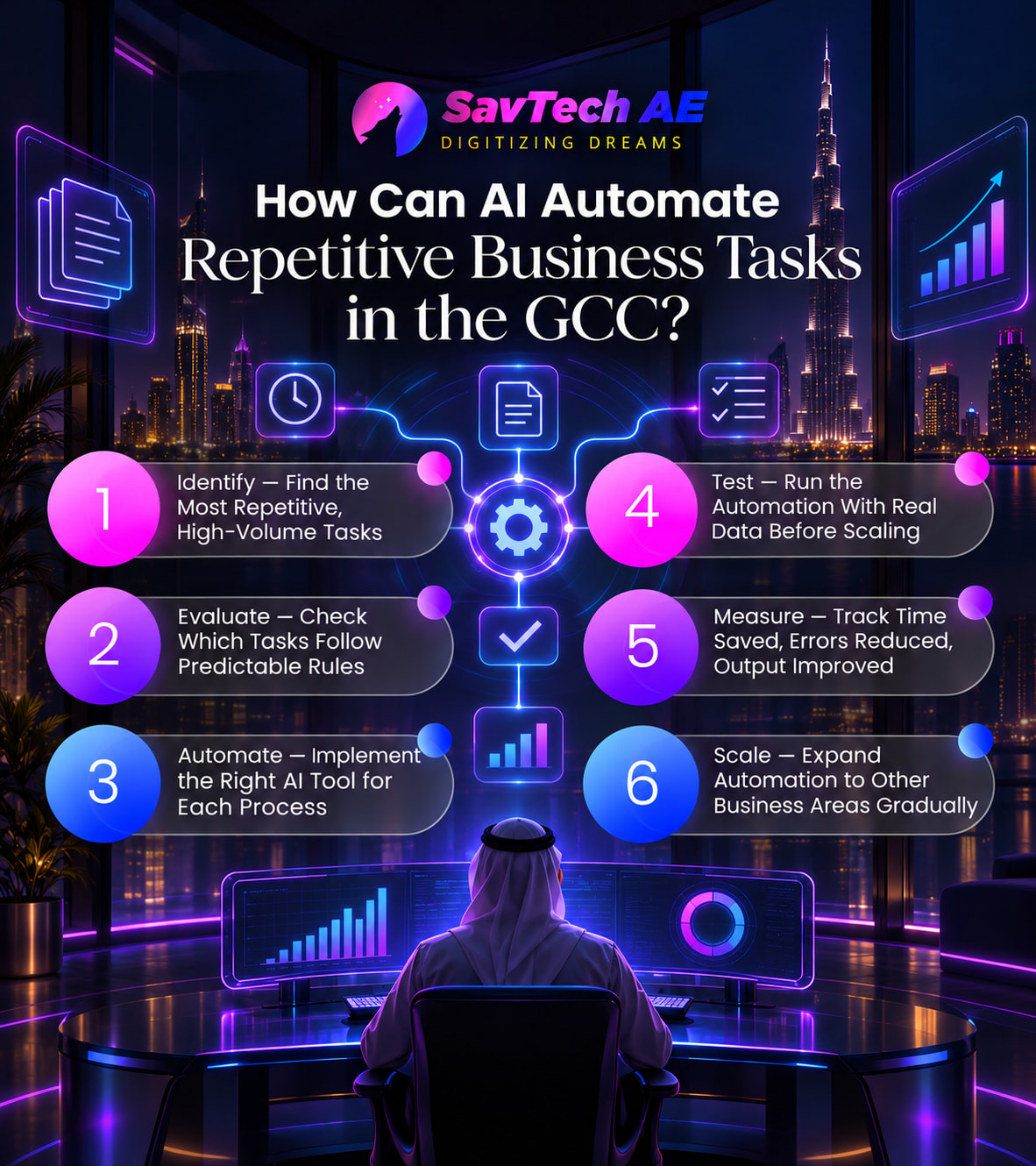
The best way to kickstart an automated repetitive task through AI is not to try to do it all at once, but rather to pinpoint the most expensive, most time-consuming, and most prone to errors among the repetitive tasks you perform in your business and then go from there.
Identify means compiling a list of all tasks that your team does repetitively. This can be done by consulting your operations manager or team leads regarding the task that takes up the most time. Patterns will emerge quickly and the tasks at the top of that list are your starting points for AI automation GCC implementation.
Evaluate means checking whether the identified tasks are genuinely automatable do they follow predictable rules, use consistent input formats, and produce consistent output types? If yes, they are strong candidates. If they require frequent judgment calls or significant variation in how they are handled, they may need human oversight even after partial automation.
Automate, Test, Measure, and Scale complete the cycle. Carry out automation in a structured manner, implement it side by side with the current manual process for some time to ensure its accuracy, determine time savings and changes in the error rate, and then apply it to other processes once the first part proves itself useful.
The providers of enterprise AI solutions and the AI consultancy GCC experts can assist companies in the process of automating processes much easier in terms of detecting possible areas of automation, recommending software, implementing it, and integrating into the company’s systems. In case there are no technical resources in a company, this is especially important.
Conclusion
The objective behind implementing AI technology in order to automate repetitive business processes is not to add sophistication to your business. It is to get those precious hours that your employees currently spend on tasks which an automated process can take care of, so they can utilize them towards doing what really makes your business grow.
Organizations operating in the GCC region, whether in the UAE, Saudi Arabia, Qatar, or elsewhere, that are automating their repetitive processes today are doing so for a reason other than fashion competitive pressure is high, costs of inefficient manual efforts can be calculated, and the solution is available and affordable today.
Those organizations that begin to identify and automate their repetitive processes today will have several months of learning and productivity gains accumulated until their competitors start following suit. This gap will continue to grow over time. In fast-paced GCC markets, this is a definite competitive advantage.
Here at SavTech Digital, we assist companies operating in the UAE & GCC regions to pinpoint the precise areas within their AI solutions for Middle East processes that yield the quickest and most tangible outcomes and then ensure automation implementation is done right through integration and support.
Ready to find out what your business can automate? Talk to SavTech Digital today for a free AI workflow assessment.