
Eighteen months ago, you subscribed to a CRM solution. Eighteen months ago, you set it up. Eighteen months ago, you got the whole team trained on it. For the first few months, things were fine. But then things changed. You had your team maintain their own spreadsheets since the CRM report did not have the information they required. You installed another software because the CRM cannot integrate with your internal software. You keep finding workarounds for all new processes your company implements because the software is not designed around how your company works.
And your story happens more often than you would imagine throughout the GCC region. This doesn’t mean that your company is badly run; it simply means your company has grown beyond the capabilities of the software you used. And it brings up a question that business owners in Dubai, Riyadh, and Doha eventually ask: does our business need a custom CRM, or are we just not using the existing one well enough?
The blog provides you with a structured and honest means by which to answer this question. It does not do so with an agenda of custom development in mind; rather, it does so in the true spirit of giving you insight into which solution is right for your organization.
Why This Decision Deserves Careful Thought
The Wrong CRM Choice Costs More Than Time It Costs Business Growth
A CRM system that does not match the business causes problems at every point in the customer relationship process. The sales team is spending its time on CRM management rather than customer management. The managers do not have faith in the information since it is incomplete and inconsistent. Information is manually compiled through different sources. And as the business gets bigger, the mismatch between the CRM system and the business increases in the same proportion.
Business CRM software that fits well does the opposite. It minimizes the administrative overhead. It brings out the data that the team needs precisely when they need it. It handles follow-up and reminders that might be missed otherwise. And it grows with the business rather than slowing it down at each turn.
Given the level of importance of this choice, being thoughtful about it instead of going by the lowest price or most fashionable platform is certainly worth the effort. A good CRM, whether standard or custom-built, pays for itself through the leads it generates, the follow-ups it manages, and the customer connections it makes. A bad one loses you money through subscription fees, wastes your time through workarounds, and misses your opportunities through inefficiency.
When an Existing CRM Platform Is the Right Answer
Off-the-Shelf Works Brilliantly For the Businesses It Was Designed For
The most important thing to say first is that existing CRM software UAE and GCC businesses widely use is genuinely excellent for a large proportion of companies. Salesforce, HubSpot, Zoho, and Pipedrive represent mature, stable systems supported by large communities, updated regularly, and having a lot of documentation available. For companies that do not require special customization for their sales process and have relatively standard needs, such solutions offer great value out of the box.
If you have your sales people managing leads, going through deal pipeline, sending follow-ups, and want basic tracking for conversion rates and team performance all of it can be done using properly set up ready-made solution. The important part here is the word “standard”. If the way your business operates is close enough to what the platform expects, then the fit will be good and the value will be there.
Existing platforms also win in terms of implementation speed. Popular CRM solution can be implemented within days and weeks, with the team up and running in no time. Custom CRM implementation is slower since it has to be built from scratch. For companies that need to get their CRM implemented fast and have relatively standard needs, it makes a difference.
When a Business Need a Custom CRM Becomes the Right Conversation
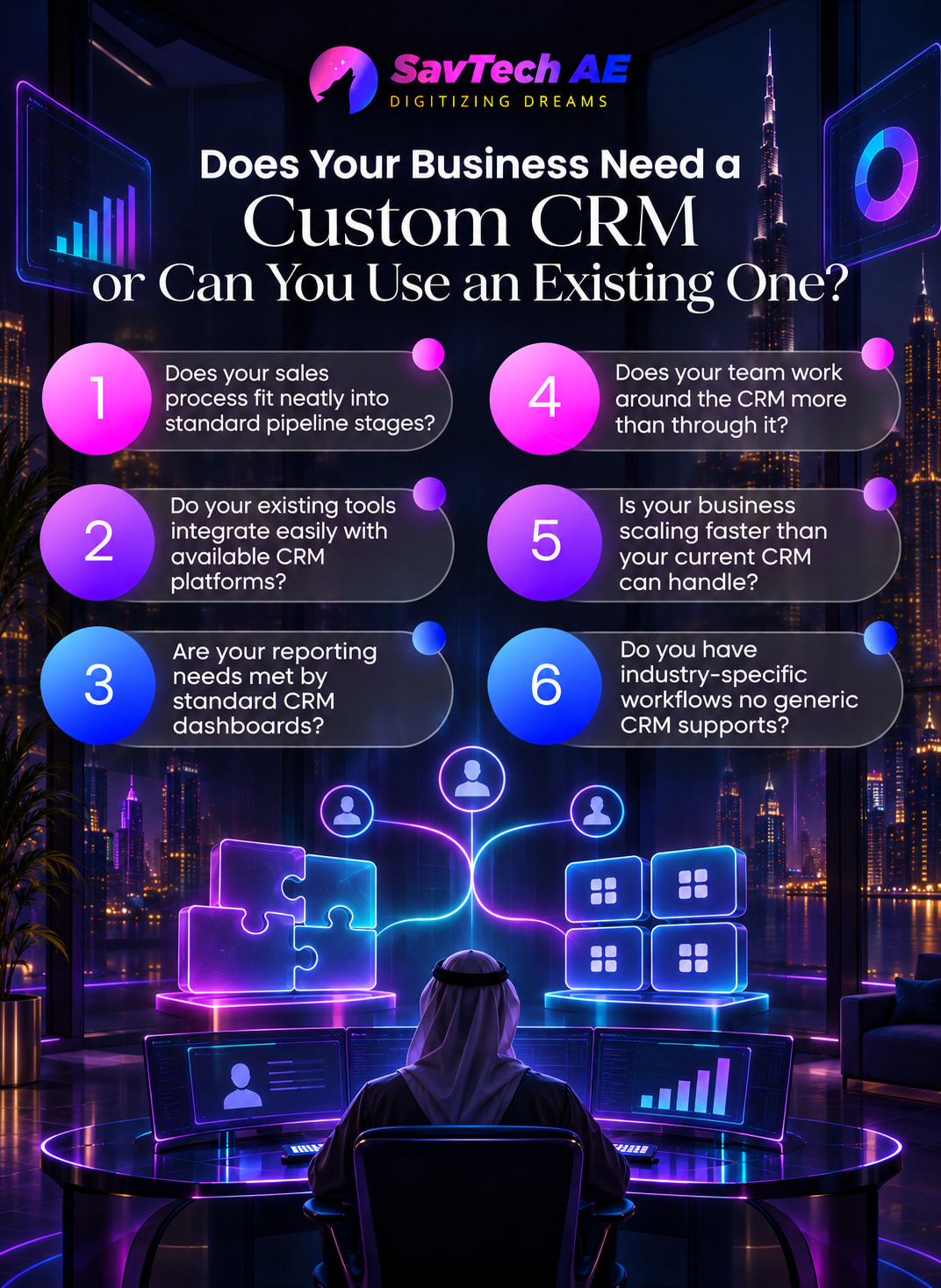
Six Signals That the Standard Platform Is Holding Your Business Back
Signal 1 Your workflow does not map to any standard pipeline. The real estate companies doing off-plan property sales in Dubai with developer payment schedule, NOC and phase handover are running a process flow for which there is no off-the-shelf CRM designed. The team finds itself changing its process flow to be able to use the CRM and not the other way around. the case for custom CRM development becomes concrete.
Signal 2 Integration with your key systems is not available. GCC firms often rely on sector-based software programs, proprietary internal systems, or region-based software programs which are not automatically linked to commonly used CRMs. In case it becomes necessary to manually transfer customer information from one program to another double entry, importing/exporting, or manual copying and pasting by the staff member the resulting inefficiency gap is what your custom CRM system can help close.
Signal 3 The reports you actually need do not exist in the platform. A logistics firm in Qatar looking to calculate the rate of on-time delivery against each customer as well as pipeline information is expecting something that does not come up in any standard CRM reporting. The fact that weekly management reporting requires CRM data to be exported to an Excel sheet every single time is proof that reporting of the platform is not fulfilling its purpose. A customer management system built around the company’s actual KPIs reports natively on what matters without any manual assembly.
Signal 4 Your team builds workarounds regularly. This is the strongest indicator yet. If the members of the team are developing their own ways of doing things in addition to the CRM system, since the CRM cannot do what they want it to do, the system has failed. Workarounds are costly as they involve using time to compensate for a failing system, not to use it, and there is always a risk of error each time they happen. A company that constantly works around its CRM needs another CRM system.
Signal 5 You are scaling and the platform is slowing down. While a CRM which is working perfectly for fifty customers may have problems when scaled to five hundred whether it be in performance, management of users, number of automations that can run at once, or subscription pricing per additional user CRM solutions GCC are developed with growth in mind from the start to ensure a non-disruptive switch in the worst possible time.
Signal 6 Your business has multi-country or multi-language requirements. Companies that are present in both UAE, Saudi Arabia and Qatar may need a CRM that can manage an interface in both Arabic and English, various currency formats and country-wise reports, among others. Although there are CRM systems which have multi-language support, the range of support offered by each system varies a lot – and companies for which language support in CRM is an important factor may benefit from a custom CRM solution.
The Role of CRM Automation in This Decision
How Well the CRM Automates Your Specific Workflows Often Decides the Question
CRM automation is one of the most valuable features of any CRM and the quality of that automation relative to your specific needs is often what tips the decision one way or the other. Most out-of-the-box CRMs allow automation of standard triggers: a lead comes in, assign it to someone and send a welcome email. The deal has closed, change the pipeline stage and inform the manager. This is good automation for a standard process.
What is lacking is the capability of automation for triggers specific to your business processes that will not be recognized by the standard platform. For instance, an automated appointment scheduling for three months after completion of treatment, verifying the insurance eligibility of the patient and informing the appropriate department if the insurance has expired at the time of renewal for a healthcare clinic in Riyadh would require automation that a standard platform cannot provide natively. Automation of such processes requires a customized system.
This difference automation of standard processes and automation of your processes – is one of the most critical considerations in choosing whether to have a custom CRM or an existing one. If your processes are standard, automation is already available. If your workflow is specific to your industry or your business model, custom CRM solutions built around those exact triggers are what deliver real operational improvement rather than partial coverage with manual bridges filling the gaps.
Industry Examples Across the GCC
Where the Custom vs Existing CRM Decision Is Most Frequently Faced
Real estate in the UAE and Saudi Arabia consistently produces strong cases for custom CRM development. Complexity associated with off-plan sales, dealing with multiple developers, payment milestone management, and compliance requirements results in workflows which can be managed poorly by the standard platform. Real estate companies from Dubai and Riyadh with custom CRM development Dubai systems report a notable reduction in loss of leads and follow-ups compared to what they used to see on the generic platforms.
B2B professional services firms in Qatar and Kuwait encounter a slightly altered form of this problem. Companies dealing with lengthy sales processes, multi-party approvals, proposal management, and service delivery process workflow require a CRM solution which takes into account the true complexity of the sales process rather than some simplified version of it.
Healthcare across the GCC is an industry where generic CRM platforms consistently miss the mark. Patient records, clinical follow-up requirements, insurance coordination, and appointment management are specialized workflows that require purpose-built systems. For healthcare providers in Abu Dhabi, Riyadh, and Doha, a custom customer management system built around clinical and administrative workflows delivers outcomes that no general sales-focused CRM platform can replicate.
Conclusion
The answer to whether your business need a custom CRM is not found in a feature comparison spreadsheet. It comes from looking honestly at the way your team operates today, finding out where the friction is coming from, identifying what your current platform does not allow you to do even after all your efforts to get it to work, and the amount of time your team spends working around the system because it wasn’t built for your unique processes.
Businesses that have standard processes and standard integration needs “existing platform, correctly configured and used” will be the solution for you, while businesses with complex and specific processes and integrations that require a custom dashboard and custom CRM development are the investments that will eliminate friction and allow for further growth.
At SavTech Digital, we do not assume every GCC business needs a custom CRM. We examine how your business works in reality and determine what it needs in terms of processes, integration, reporting and growth, and make you an honest suggestion which way you should go. Whether an off-the-shelf platform is what you need, or whether you have to go for a custom-built solution, we know how to do it.
Not sure which CRM approach is right for your GCC business? Talk to SavTech Digital today for a free CRM evaluation.