
You have an application idea in mind. Perhaps it is a food delivery platform, a property searching application, an appointment booking app, or maybe even a loyalty application for your own brand. You google the cost to build a custom mobile app and find out how diverse the costs of development are and no one gives you an answer that seems clear. Why would one application cost much more than the other doing the same thing?
There’s no easy answer; even similar apps can be worlds apart. An ordering application for a restaurant, which is limited to just one spot and a simple menu, will have nothing in common with the delivery service handling many restaurants, drivers in real time, payments, and reviews. They both are ordering applications, but there’s a great difference in their complexity, development, and the way to develop them correctly.
This blog post is not a pricing guide; it’s something far more helpful. It will give you all the factors that decide the cost of building a custom mobile app in the UAE, the decisions that affect your total investment from the very beginning, and all the questions you should consider before developing an app. And knowing this information beforehand will save you money and time.
What Actually Determines the Cost of a Custom Mobile App?
It Is Not Just About the Number of Screens
Most entrepreneurs in Dubai and Abu Dhabi tend to commit a mistake of looking at the application from a screen perspective, which means “I want to have approximately ten pages; how much does it cost?” The thing is that screens are only an interface; the cost depends on what goes on under the screens the logic, data handling, connectivity with other applications, and control over every user’s action.
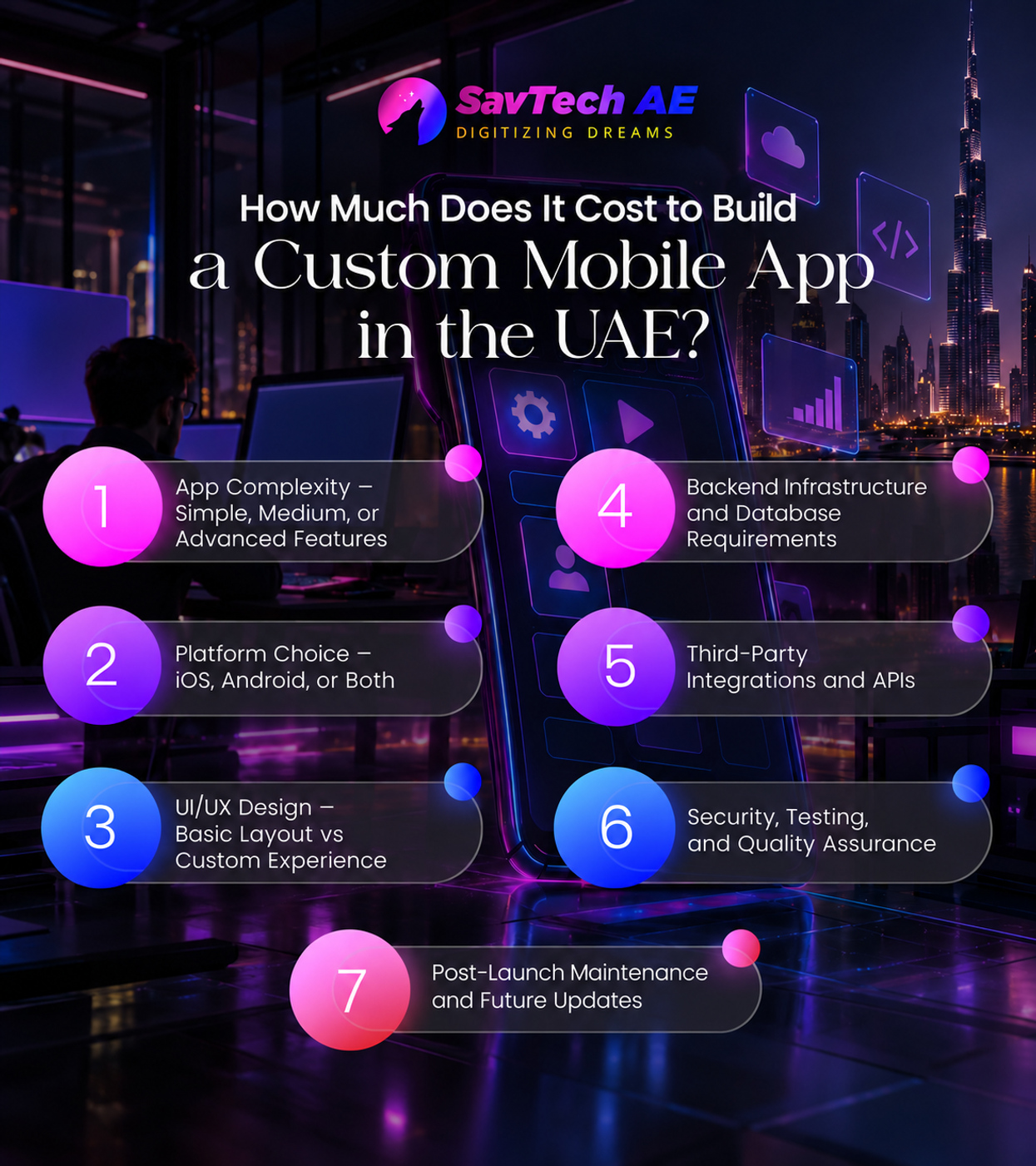
Custom mobile app development cost is shaped by the combination of features required, The platforms on which the application should be developed, its user interface design, data storage methods, interaction with third-party applications and systems, security requirements, and the amount of maintenance that the application will require after its launch. Any change in one of these elements requires changing the development scope and investment required for its realization.
Two applications that both display the list of properties on a map might differ in their development complexity due to having basic filters and a form to leave contacts for a real estate agent in one case versus using the live property database, having AI-based recommendations, supporting Arabic and English languages, processing payments, and sending automatic messages to potential buyers. The main question here is not “What is an application for?” but “How is it done and how many users will use it? How much data will it process?”
iOS, Android, or Both Which Should Your Business Choose?
Platform Choice Has a Direct Impact on Development Scope
One of the first and most important decisions when you build a custom mobile app is which platform to target. For the UAE, both iOS (iPhone) and Android enjoy popularity among their users. In fact, iPhone is highly favored by professionals and the richer classes in Dubai, but the popularity of Android transcends to more people and even to the wider GCC region.
When developing applications for the two platforms independently, two different sets of codes need to be developed; thus, requiring two different sets of developers. However, today’s business app development takes advantage of cross-platform technologies which enable the development of one code that works on both iOS and Android.
Cross platform app development is a smart choice for many UAE businesses especially those which are startups and SMEs which wish to target both groups from the outset, without having to double their spending. However, one needs to realize that the cross-platform development solution is not always the best one. Applications that have very special hardware requirements, advanced graphics or need maximum performance like AR tools or real-time processing applications might be better off as a native application.
Simple App vs. Complex Business App What Is the Difference?
Complexity Defines the Scope and the Timeline
A perfect example of an app that does not have to perform all those functions is a simple one. Understanding where your application stands in terms of complexity is one of the best activities you can engage in before talking to the developers. A simple application will be composed of a few screens, basic user interaction, no real-time data, and no integrations. Imagine a digital menu of a café, an online booking form for a salon, or a catalogue of a simple product.
A medium-complexity mobile app development UAE project introduces user accounts with registration and login, payment processing, push notifications, and limited integration capabilities (with another system, such as a calendar appointment scheduler or CRM). E-commerce platforms, clinics booking systems, or business services apps belong to this category. The development of such projects involves more planning, more time spent on development itself, testing, and managing after launch.
A sophisticated application can be a logistics tracking system, multi-vendor e-commerce site, telemedicine health care platform, or even a real estate app with AI technology that automatically matches users with properties. All those applications require the whole backend architecture, API integrations, advanced security solutions, real-time data synchronization capabilities, and technical maintenance after deployment. These are the kinds of projects that will take a lot of time and expertise to complete. Understanding which type your project belongs to is the first step to realistic conversations about its development.
Why UI/UX Design Matters More Than Most Businesses Think
A Beautiful App Nobody Can Use Is a Wasted Investment
UI is your app’s appearance while UX is its feel. In the UAE, a place where people constantly deal with excellent apps belonging to some of the best companies in the world, the bar is set pretty high for both aspects. Any app which does not have an updated appearance, confuses people or requires several clicks to do something simple will be instantly uninstalled. Once a person uninstalls your app, you won’t get them back easily.
Good custom app development design is not about adding decorative elements It’s all about making the interactions simple and intuitive. It’s all about the user not having to think about what buttons they need to tap. It’s all about a checkout process consisting of only three steps instead of eight. It’s all about having a right-to-left adaptation of the application for Arabic speakers instead of its translated copy.
Investing in UI/UX design correctly is one of the most profitable decisions a UAE-based company can make when developing an app. Such app will receive more five-star ratings, be recommended from word of mouth, and attract users more successfully. It doesn’t matter whether the core functionality is advanced or not. The design is not something to save money on. It’s an amplifier of everything else.
Backend, APIs, and Third-Party Integrations
The Invisible Architecture That Makes Your App Work
All functionalities which your users will interact with through the user interface of your software application have a backend to support them, consisting of servers, database, and logic which stores data, processes the request and connects different parts of the application. The more functionality you will implement in your application, the more complicated your backend will become.
Mobile app developers UAE who build for real businesses understand that the backend is often where the most important work happens. A scheduling app that displays available slots requires a backend that handles doctor schedule management, prevents booking of reserved slots, sends out confirmation notifications, and synchronizes the schedule with a calendar app. A real estate app that searches for properties according to location, area, and budget requirements needs a database with thousands of properties and a backend that performs complex search operations at once.
Third-party integrations complicate the process even more. Payment gateways such as Telr, PayTabs, or Stripe. Mapping and location services. SMS and WhatsApp notification services. CRM integration. Social media login options. Each integration requires development, testing, and maintenance. Recognizing the integrations your application needs versus which ones would be nice to have is one of the most important scoping decisions in any mobile app development cost UAE conversation.
Security, Testing, and Post-Launch Maintenance
The Costs Most Businesses Forget to Plan For
Safety is crucial when it comes to any application that deals with customers’ data, money, or private information. As for the UAE, in which laws related to data privacy become more and more stringent, implementing safety features in your application at the very beginning is not only a requirement but also a responsibility of your business. Making shortcuts and skimping on security to save money in the process of development is one of the most costly decisions a company can make since there will be much bigger expenses for you in case of failure.
Another thing that most companies tend to underestimate is testing. Properly tested applications go through several rounds of quality assurance each of the features, possible edge cases, different devices, and screen sizes are checked before release. Applications with insufficient testing appear with errors that ruin user experience and the image of the company as a whole.
The maintenance costs incurred after the launch are the expenses that tend to come as a surprise for most of the business people from the UAE. The apps need to undergo maintenance so that they remain compatible with newer versions of operating systems released by both Apple and Google. The security fixes also have to be done. App development pricing conversations should always include a clear discussion of what post-launch support looks like because an app without ongoing maintenance will degrade in quality and user experience over time.
Common Mistakes UAE Businesses Make When Planning an App
Avoid These Before You Start Not After
The most common mistake businesses in Dubai and Abu Dhabi make when planning to build a custom mobile app is starting with the wrong question. These individuals ask “how much does it cost?” before they have defined how the app functions, its audience, and the problem it solves. Without having the information, any estimate provided by a software development company is nothing but speculation, and speculations inevitably lead to mismatched expectations, excessive budgeting, and underperforming apps.
Another common error when developing an app is that of trying to implement too many things in the first release. Businesses include as many features as possible into the scope in the beginning just to make the app fully functional right from day one. This not only makes the development process longer and increases its price but also means that it starts to produce value later than expected. It is better to develop and release an app that has the core features providing the maximum value and learn how your audience uses it and then release new updates with additional features.
Another mistake made by entrepreneurs when building an app in UAE is of choosing the cheapest solution without checking the quality of developers’ previous projects, their post-release services, and their knowledge of UAE’s market. Custom mobile app development done poorly is not cheaper it is more expensive, because fixing a badly built app almost always costs more than building it correctly from the beginning.
Questions to Ask Before Hiring Mobile App Developers in UAE
These Questions Protect Your Investment
When choosing a company to build an app, there are certain questions you need to ask before agreeing to any partnership. Can I see some examples of the apps you’ve worked on? How do you deal with changes in the scope? What is your testing process? Who is going to be my main point of contact? What are the specifics of your post-launch support?
Ask them about their experience working with UAE market specifically. Building an application for your specific audience requires knowledge of Arabic localization, UAE local payment gateways, UAE data protection requirements, and cultural peculiarities of your users in Dubai and Abu Dhabi. These nuances can’t be just figured out at the very beginning of the development process.
Moreover, ask about the style of their communication within a project. Are there going to be weekly progress reports? Is there going to be some project management tool accessible to me? Am I going to see some results even before the final product is delivered? Proactive communication, regular demos and quick response to any questions weigh more than fast delivery.
Conclusion
The cost to build a custom mobile app in the UAE is not a fixed number it’s the result of hundreds of decisions made long before any actual development starts. The platform to be used, the list of features, the design of your product, its back-end, integration options, security, and post-launch support make up the essence of your project and therefore the cost of building it.
The companies that reap the biggest benefits from their investment in apps are not those who were offered the most affordable quote. It was those that spent some time to think through the requirements of their app, choose a development company with experience in this particular area, invest in good design and testing and think through maintenance from day one. This way, you receive the app you can be proud of, which will serve you and your customers well.
When you’re ready for a serious and informed discussion of what your app should look like and how to develop it correctly, we are ready to talk. No pressure, no empty promises – just experience and pragmatic advice based on your and your market specifics.
Looking to discuss your app properly? Contact us now for a free consultation.